The challenge of managing ageing structures relates in essence to decision making under tight budgetary as well as operational constraints taking into account costs for inspections, repair and upgrading, but keeping in mind human safety. Hence, it is evident that efficiency or optimization in the asset management can result in substantial economic savings. Information on the condition of the structure is the necessary basis for deciding on a multitude of actions which can be taken to ensure safe operation of the structure within its projected lifetime or for prolonging its lifetime. Within the frame of this doctoral research project, it will be investigated how the predictive performance of FE models of existing concrete structures can be improved by calibrating these models based on combined monitoring & inspection data, focusing on both local and global vibration-based monitoring data as well as long-term strain measurements. As a variety of different combined monitoring & inspection strategies exist, this doctoral research project will develop an optimization algorithm based on the concept of Value of Information (VOI), allowing to select the optimal strategy.
Research results
The assessment of concrete structures is traditionally conducted using visual inspection, but they fall short in providing comprehensive and real-time information on the structural condition. In WP3, the usage of vibration-based monitoring (VBM) for this purpose is investigated. VBM tracks the evolution of modal characteristics (e.g. natural frequencies, strain mode shapes) of the structure. Thesemodal characteristics are sensitive to stiffness changes in structural components, and can hence be used for damage detection, localization and quantification.
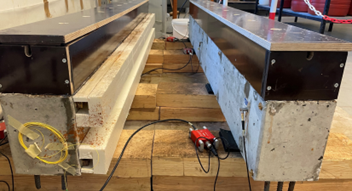
The research conducted in WP3 combines experimental investigations with finite element (FE) modelling. In laboratory conditions, reinforced concrete beams are subjected to an accelerated corrosion process and to mechanical loading, while being monitored using accelerometers and FBG strain sensors. Afterwards, a Bayesian updating methodology is applied to couple the identified modal characteristics and FE models.
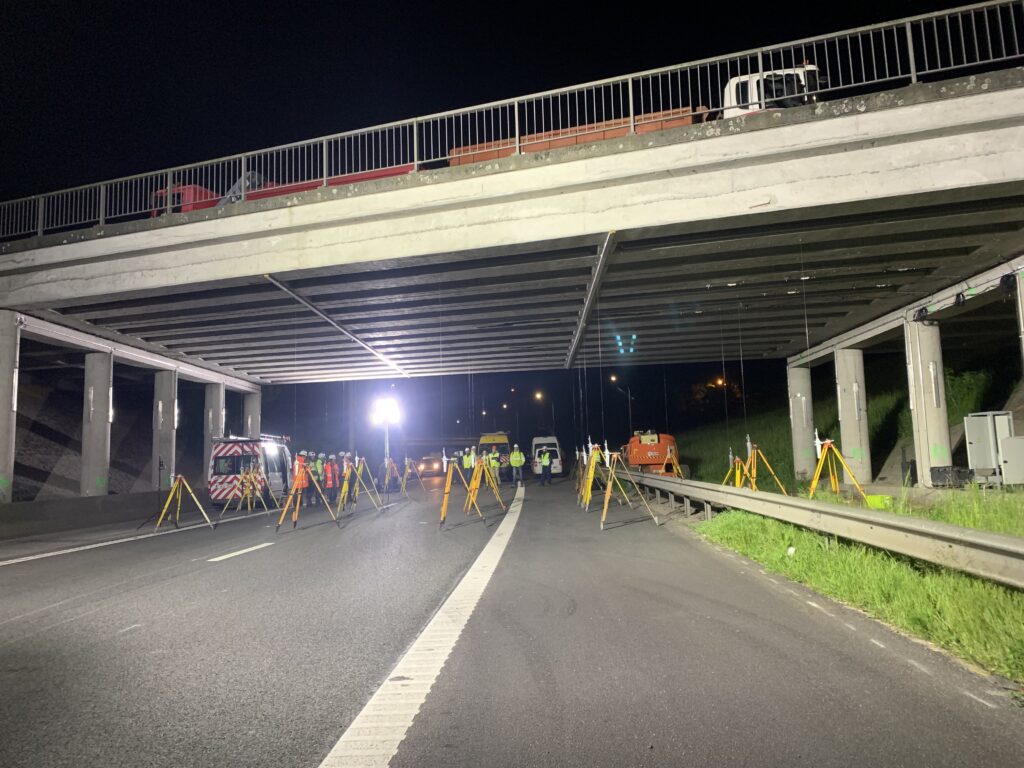
The methodology is tested on an actual bridge structure. A post-tensioned concrete girder bridge is monitored for more than two years using over 250 FBG strain and temperature sensors. The influence of environmental and operational variability (EOV) on the static strain data and modal characteristics is studied in detail, as well as the influence of damage.
The main conclusions of this research are the following:
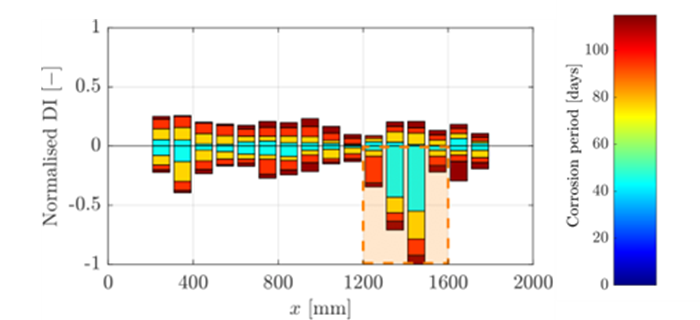
In laboratory conditions, natural frequencies allowed the detection of corrosion and loading induced cracks, while strain mode shapes were able to also localize local corrosion
By integrating modal characteristics with FE models, improved stiffness estimations were obtained, but quantification of the corrosion degree remains highly challenging.
For the case study, a significant influence of EOV (e.g. temperature, solar irradiation) on the strain data and modal characteristics is observed.
After removing the influence of EOV, the occurring damage was successfully detected using the FBG strain data.
Damage indicator based on the strain mode shapes for increasing corrosion degrees of a locally corroded beam. The damaged zone is highlighted in orange.
main objectives
This workpackage aims for the following Deliverables (D) and Milestones (M):
D3.1 – Uncertainty quantification and verification of effectivenees of selected combined inspection/monitoring strategies
D3.2 – Optimization algorithm for selected inspection/monitoring strategies
M3.1 – Selection of promising combined inspection/monitoring strategies (input for WPs 1,2,4,5,6,7)